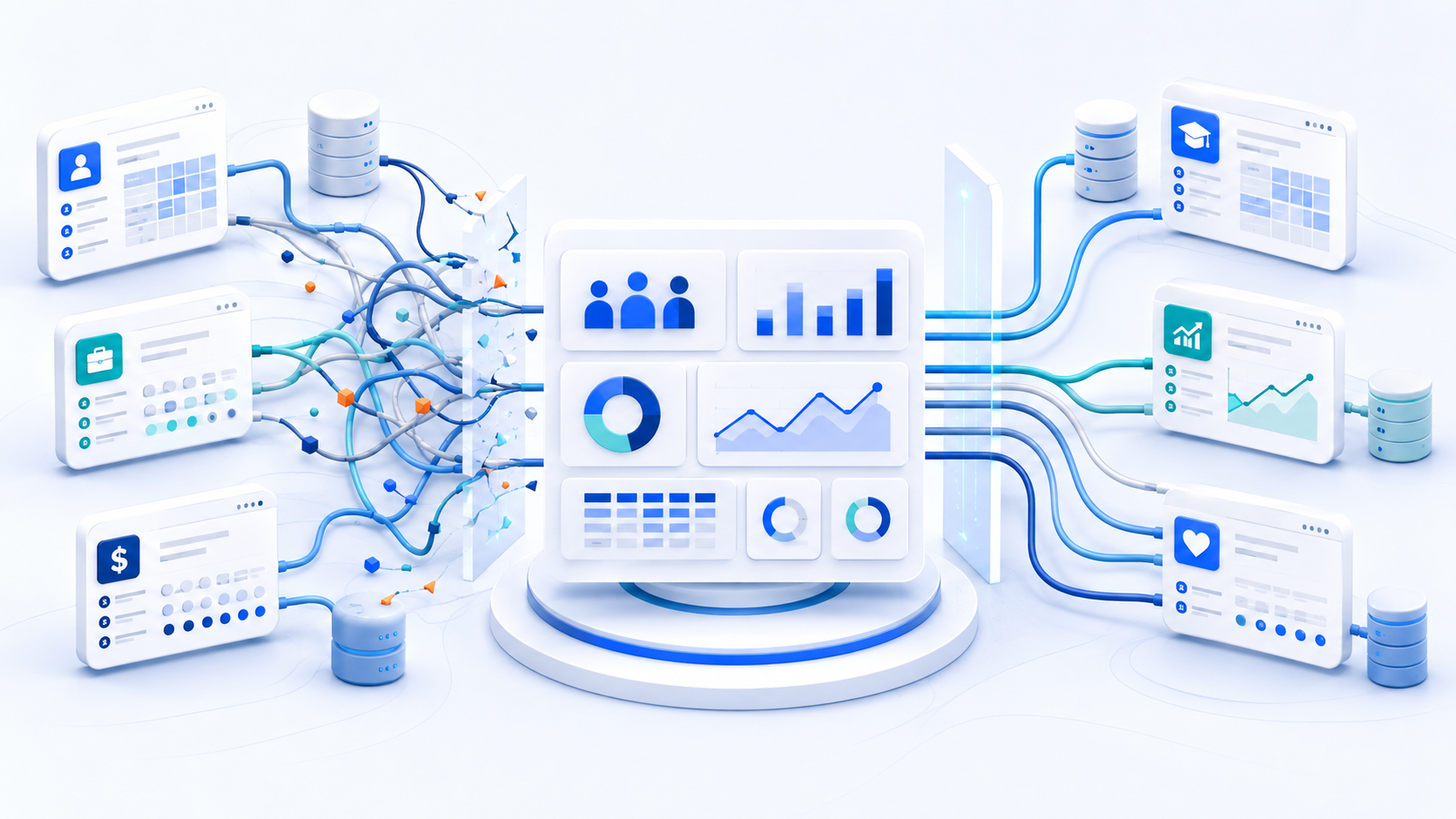
Why Fragmented HR Systems Make Workforce Reporting So Difficult
Most organizations do not have an HR data problem.
They have an HR data fragmentation problem.
The challenge isn’t collecting more workforce data. It’s making the data you already have accessible, consistent and actionable.
Employee information exists across payroll systems, applicant tracking systems, HRIS platforms, learning management systems, performance tools, and other HR technologies.
Each system serves a specific purpose.
The problem appears when HR leaders need to answer a workforce question that requires information from more than one of them.
Suddenly, a simple question becomes a data consolidation project.
Why Is HR Data So Fragmented?
The average HR technology environment evolves over time.
Organizations introduce new systems to solve specific operational needs.
A recruiting team implements an applicant tracking system.
Payroll uses a dedicated platform.
Learning and development introduces an LMS.
Performance management moves into another application.
Employee engagement data may exist in a survey platform.
Each system improves a specific HR process.
However, the organization’s workforce data becomes distributed across an increasingly complex technology ecosystem.
This creates a fundamental reporting challenge:
Operational HR systems are designed to manage HR processes. They are not necessarily designed to connect workforce information across systems or answer strategic business questions.
What Does a Fragmented HR Technology Stack Look Like?
Consider a mid-sized organization using several HR systems.
Employee information is stored in the HRIS.
Payroll and compensation data exist in a payroll platform.
Candidate information is stored in an applicant tracking system.
Training records are managed through an LMS.
Performance information exists in a separate application.
Each platform may offer its own reporting capabilities.
The challenge begins when leadership asks a question such as:
Are employees with lower training completion rates more likely to leave the organization?
Answering this question may require information from:
- — the HRIS
- — the learning management system
- — payroll or employee status records
The HR team must then extract, clean, match, and combine the data before analysis can begin.
The difficulty is not necessarily calculating the answer.
The difficulty is preparing the data required to answer the question.
Until the data is connected and trusted, meaningful workforce analysis cannot begin.
How Do Fragmented HR Systems Affect Reporting?
Fragmented HR data creates several operational challenges.
1. More manual data preparation
HR teams frequently export information from multiple systems into spreadsheets.
The data must then be cleaned, standardized, and combined.
This process may need to be repeated every reporting cycle.
A monthly workforce report can therefore become a recurring manual data project.
2. Inconsistent workforce metrics
Different systems may calculate similar HR metrics differently.
One platform may define headcount using active employees at the end of the month.
Another report may use average monthly headcount.
A spreadsheet maintained by another employee may use a different calculation entirely.
Without standardized HR metrics, organizations can produce multiple answers to the same workforce question.
3. Slower access to workforce information
Leadership questions do not always align with existing reports.
A new question may require HR to return to several systems, export new files, and rebuild the analysis.
This creates delays between asking a workforce question and receiving an answer.
4. Increased reporting dependency
Complex reporting processes often become concentrated with specific employees.
One person knows which reports to export.
Another understands the spreadsheet formulas.
Someone else knows how the HR systems map together.
This creates operational risk.
If a key employee is unavailable, reporting may become difficult to reproduce.
5. Limited cross-system analysis
Perhaps the largest limitation of fragmented HR systems is that they make more sophisticated workforce analysis difficult.
Important workforce questions frequently involve several variables.
For example:
- — Is turnover higher among employees with lower engagement scores?
- — Do departments with longer hiring cycles experience greater vacancy costs?
- — Is training participation associated with internal mobility?
- — Are compensation patterns related to retention?
- — Which workforce characteristics are associated with absenteeism?
The data required to investigate these questions may exist.
But it exists in different systems.
Why Don’t Individual HR System Dashboards Solve the Problem?
Modern HR platforms frequently include dashboards and reporting tools.
These tools can be valuable.
However, they typically provide the strongest reporting capabilities for data stored within their own platform.
An applicant tracking system is excellent at reporting recruiting activity.
A payroll system can provide detailed compensation information.
An LMS can report training participation and completion.
The limitation appears when an organization needs to analyze information across these systems.
Adding more dashboards does not necessarily create a unified view of the workforce.
In some cases, it simply creates more places to look for information.
The question organizations should ask is not:
“Do our HR systems have dashboards?”
The better question is:
“Can we easily analyze workforce information across our HR systems?”
Why Do HR Teams Still Rely on Excel?
Excel remains one of the most common tools used in HR reporting.
There is a practical reason for this.
Spreadsheets often become the integration layer between disconnected HR systems.
HR teams export data from several platforms and combine the information manually.
Excel provides the flexibility required to clean, match, calculate, and visualize the data.
The problem is not Excel itself.
Excel is an incredibly powerful tool. The issue arises when it becomes the organization’s long-term integration strategy instead of a tool for analysis.
This can create:
- — repetitive manual work
- — version control issues
- — inconsistent calculations
- — reporting dependencies
- — limited data accessibility
- — difficulty scaling the reporting process
A spreadsheet may solve today’s reporting question.
It does not necessarily create a sustainable reporting process for tomorrow.
Do Organizations Need to Replace Their HR Systems?
Usually, no.
HR data fragmentation does not automatically mean the underlying HR systems are inadequate.
Each platform may perform its operational function extremely well.
Replacing payroll, recruiting, learning, or performance systems simply to improve reporting can be expensive and disruptive.
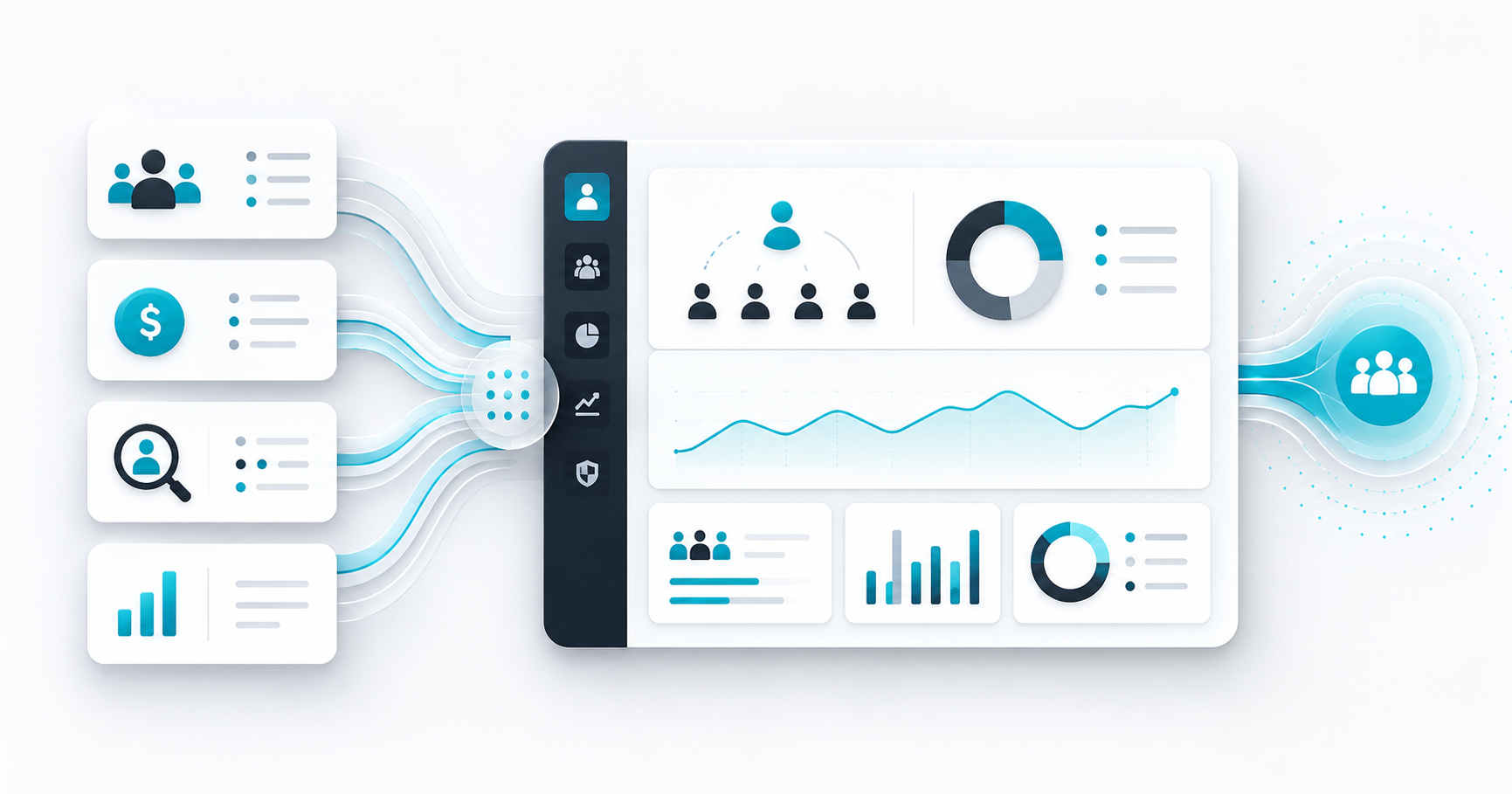
A different approach is to create a reporting and analytics layer across the existing HR technology environment.
This allows organizations to retain their operational systems while centralizing workforce information for analysis.
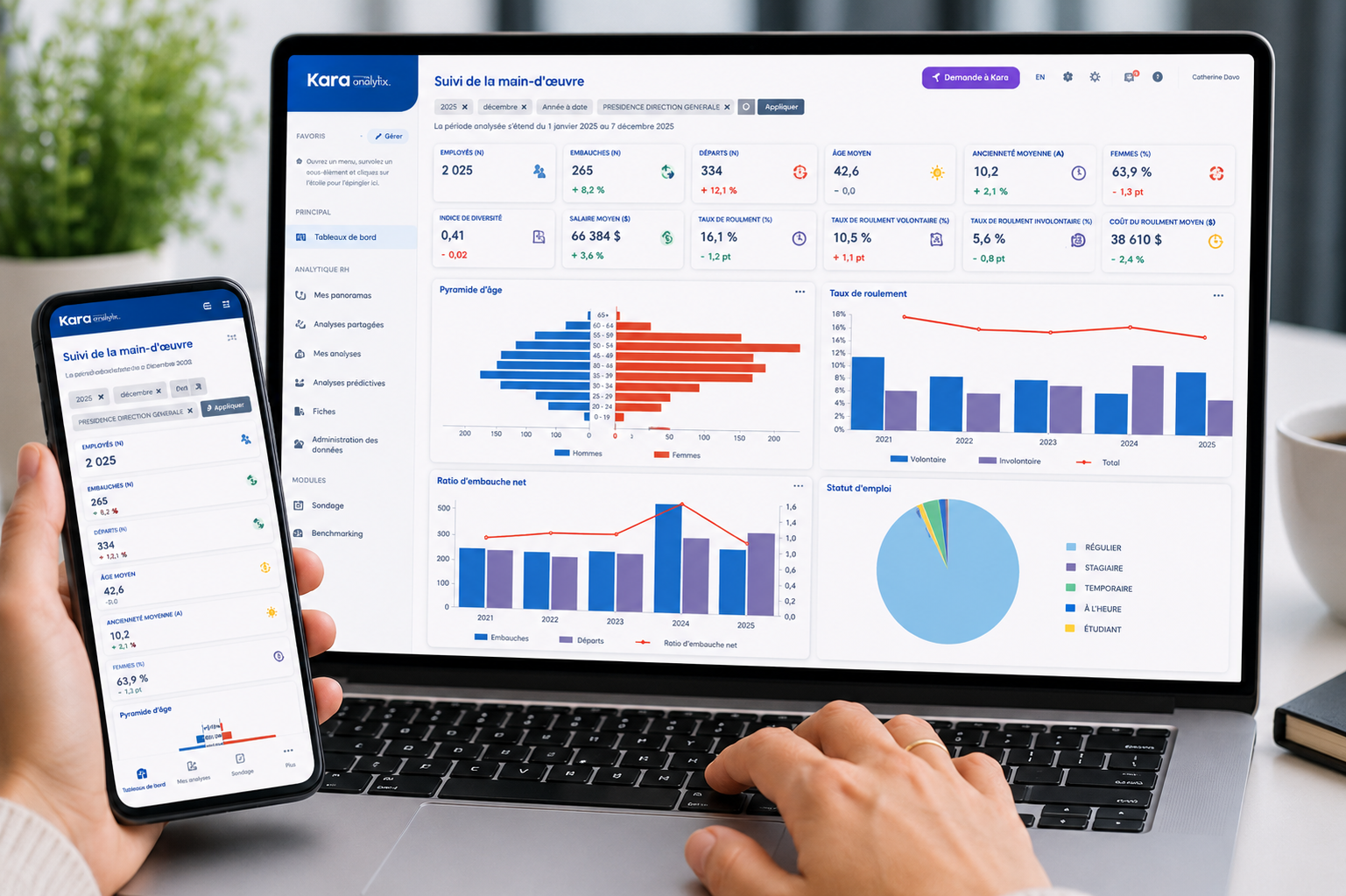
A People Analytics platform can help consolidate HR data, standardize workforce metrics, and create a more consistent reporting environment.
The objective is not necessarily to reduce the number of HR systems.
The objective is to reduce the amount of manual work required to use the information stored within them.
How Can Organizations Reduce HR Data Fragmentation?
Organizations can improve their reporting environment through several practical steps.
1. Map the HR technology ecosystem
Identify every system containing workforce information.
Document what data exists in each platform and which reports depend on it.
2. Identify recurring data exports
Review the reports HR teams create weekly, monthly, and quarterly.
If the same information is repeatedly exported and combined, the process may be a candidate for automation.
3. Standardize workforce metrics
Create consistent definitions for important HR KPIs.
Metrics such as turnover, headcount, absenteeism, and time to hire should use agreed-upon calculations.
4. Identify cross-system reporting questions
Document workforce questions that require information from multiple platforms.
These questions often reveal the largest limitations in the current reporting environment.
5. Centralize workforce reporting
Create a consistent analytical environment where HR data can be reviewed across systems.
This can reduce spreadsheet dependency and improve access to workforce information.
6. Automate recurring reporting processes
Reports that are rebuilt using the same data sources and calculations should be evaluated for automation.
The objective is to shift HR capacity away from repetitive data preparation and toward workforce analysis.
What Is the Business Impact of Fragmented HR Data?
The cost of fragmented HR systems is not limited to the hours spent preparing reports.
Fragmentation can affect how quickly organizations understand workforce changes.
A retention issue may take longer to identify.
Recruiting bottlenecks may remain hidden across systems.
Workforce trends may only become visible during quarterly reporting.
Leadership may receive workforce information after important decisions have already been made.
Improving HR reporting infrastructure creates a shorter path between:
Workforce question → Reliable data → Insight → Decision
The shorter that path becomes, the more useful workforce information becomes.
The cost of fragmented HR data isn’t simply slower reporting. It’s slower decisions.
How Fragmented Is Your HR Reporting Environment?
If your HR team regularly exports data from multiple systems, combines spreadsheets, or manually rebuilds workforce reports, your reporting environment may contain hidden inefficiencies.
Kara Analytix’s HR Reporting Efficiency Calculator evaluates your current reporting process and estimates:
- — the cost of manual HR reporting
- — your HR reporting maturity level
- — potential reporting efficiency opportunities
- — estimated time savings
The assessment takes approximately two minutes.
→ Assess Your HR Reporting Environment
FAQ
What are fragmented HR systems?
Fragmented HR systems are separate HR technologies that store workforce information across different platforms, making it difficult to analyze employee data together.
What is HR data fragmentation?
HR data fragmentation occurs when workforce information is distributed across multiple systems, spreadsheets, and data sources without a centralized reporting environment.
Why is HR reporting so manual?
HR reporting often becomes manual because employees must export, clean, and combine information from several disconnected HR systems before analysis can begin.
How can HR data fragmentation be reduced?
Organizations can reduce reporting fragmentation by mapping HR data sources, standardizing workforce metrics, automating recurring data processes, and centralizing workforce reporting.
Do companies need to replace their HR systems to improve reporting?
Not necessarily. Organizations can often improve reporting by creating an analytics layer across existing HR systems rather than replacing the operational platforms themselves.