Blog Details
- Home
- 6 mistakes that prevent your HR Dashboard from creating real value


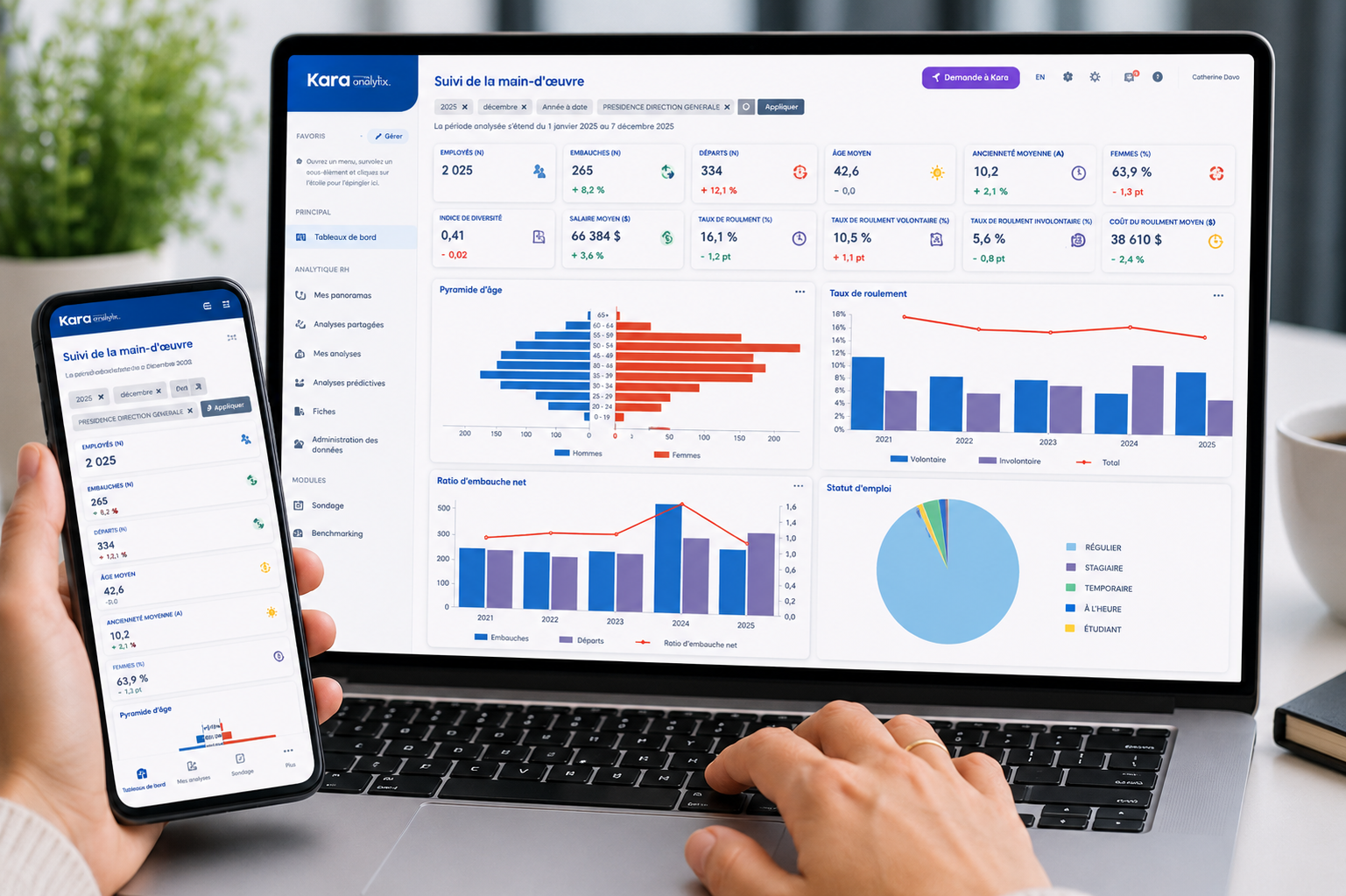
You have an HR dashboard. But are you actually making better decisions?
HR dashboards have become a standard tool in many organizations. Today, almost every organization has a way to monitor turnover, absenteeism, recruitment, workforce demographics, and other key HR indicators.
Yet one important question remains.
Does simply having access to this data actually lead to better decisions?
In many cases, unfortunately, the answer is no. Just because a dashboard is modern, automated, or updated in real time doesn’t mean it automatically creates value. A dashboard is only useful if it helps managers understand what’s happening and take meaningful action.
Here are the most common mistakes that prevent HR dashboards from fulfilling their true purpose.
When organizations implement their first HR dashboard, it’s tempting to include every available metric. After all, if the data exists, why not display it?
The problem is that a dashboard filled with dozens—or even hundreds—of KPIs quickly becomes difficult to interpret. The more information it contains, the harder it becomes to identify what truly deserves attention.
A good dashboard doesn’t try to show everything. It highlights the handful of metrics that directly support business decisions.
Before adding a new indicator, ask yourself one simple question:
If this indicator changed tomorrow morning, would it influence a decision?
If the answer is no, it probably doesn’t belong on your dashboard.
A 17% turnover rate.
An absenteeism rate of 4.8%.
An average time-to-fill of 46 days.
On their own, these numbers don’t tell us much.
Are they good? Bad? Improving? Concerning?
Data only becomes valuable when it’s placed in context.
Context is what transforms data into meaningful information.
How has the metric evolved over the past year? Which departments are most affected? Which employee groups are driving the trend? How does it compare with industry benchmarks?
The best dashboards don’t simply display indicators—they help users understand what those indicators actually mean.
No dashboard, regardless of how sophisticated it is, can compensate for poor data quality.
If information is incomplete, if definitions vary across departments, or if data comes from disconnected systems, the resulting metrics quickly lose credibility.
And when managers begin questioning a single number, confidence in the entire dashboard—and often in HR itself—can be undermined. Before producing and sharing more indicators, organizations should ensure that every KPI is built on clear definitions and high-quality data.

HR teams know their metrics inside and out. Business leaders, however, are looking for answers to business challenges.
A plant manager won’t use a dashboard the same way an HR Vice President will. One wants to understand why absenteeism is increasing within their team. The other wants to monitor organization-wide trends. An effective dashboard adapts to its audience. It delivers the right information, at the right level of detail, at the right time. The easier a dashboard is to use, the more likely people are to use it.
This is probably one of the most common misconceptions. A dashboard helps you visualize data. People Analytics helps you understand it.
For example, your dashboard shows that voluntary turnover has increased by 15%. That’s useful—but why did it increase? Is the increase concentrated within a specific team? Is it linked to a particular manager? Employee tenure? Compensation? Internal mobility?
The dashboard highlights the issue. Analytics uncovers the reasons behind it. Without that second step, organizations risk making decisions based on assumptions rather than evidence.
This is perhaps the most expensive mistake of all. Some organizations review their dashboards every month. Indicators are presented during leadership meetings, discussed… and then forgotten until the following month. But data only creates value when it leads to action.
A good dashboard should always prompt questions such as:
Why are we seeing this trend?
Should we intervene?
Which action would have the greatest impact?
Without a decision, a KPI remains just a number.
The best dashboards aren’t built to monitor. They’re built to drive decisions.
The purpose of an HR dashboard isn’t to collect data or impress people with sophisticated charts. Its mission is much simpler: to help leaders make better talent decisions.
When built on reliable data, focused on the right metrics, and designed to answer real business questions, an HR dashboard becomes a powerful management tool. It helps organizations identify trends more quickly, detect risks before they become problems, and focus resources where they’ll have the greatest impact. In other words, it transforms data into decisions.
Investing in an HR dashboard is an excellent first step. But its value shouldn’t be measured by the number of KPIs it contains or the sophistication of its visualizations. Its value should be measured by the quality of the decisions it enables.
The highest-performing organizations aren’t the ones with the most data. They’re the ones that know how to interpret it, put it into context, and turn it into meaningful action.
At the end of the day, an HR dashboard should never be just a collection of indicators. It should be a decision-support tool that empowers managers, HR teams, and ultimately, organizational performance.
Most organizations do not have an HR data problem. They
Not every organization approaches HR reporting the same way. Some
Manual HR reporting often costs more than organizations realize. The
HR reporting can be automated by connecting data from your
For many years, the HR Business Partner (HRBP) role was
You have an HR dashboard. But are you actually making
Digital transformation has become a top priority for organizations. Yet
Digital transformation has become a strategic priority for organizations of
Data has become an essential driver for HR teams. Yet
Human resources generate an impressive amount of data. Recruitment, compensation,