Blog Details
- Home
- The future of the HR Business Partner role in the age of Data

For many years, the HR Business Partner (HRBP) role was primarily centered on supporting managers, resolving people-related challenges, and maintaining a deep understanding of the organization. While these competencies remain essential, they are no longer sufficient to meet the expectations of today’s businesses.
Organizations now operate in an environment where decisions must be made quickly, backed by evidence, and demonstrate a measurable impact on business performance. In this context, HR Business Partners are expected to play an increasingly strategic role. To do so, one new capability has become essential: the ability to use data to guide decision-making.
The goal is not to replace human expertise, but to enrich the HRBP’s role by using data to support recommendations with facts rather than perceptions.
From Advisor to Strategic Partner
The HR Business Partner has always been responsible for aligning people-related issues with organizational objectives. However, they often relied on experience, intuition, or observations from the field to influence managers.
Today, that approach is evolving. When leadership is concerned about rising turnover or recruiting challenges, it is no longer enough to say that “employees seem less engaged.” HR Business Partners can now demonstrate that turnover has increased by 18% over the past year, that most departures involve employees with less than two years of tenure, or that absenteeism is particularly high within specific teams.
Data gives recommendations greater credibility. It transforms assumptions into objective insights.
Data doesn’t replace judgment
Some fear that the rise of People Analytics will reduce the HR Business Partner’s role to that of a data analyst. In reality, the opposite is true. Dashboards, metrics, and even artificial intelligence can highlight trends and anomalies, but they cannot fully explain why they exist.
For example, two teams may have exactly the same turnover rate for completely different reasons. In one team, the issue may stem from excessive workload. In the other, it could be related to leadership style, limited career opportunities, or an organizational transformation.
Data does not answer every question. Instead, it helps us ask the right ones.
This is precisely where the HR Business Partner creates value: interpreting the findings, understanding the organizational context, and guiding managers toward the most appropriate solutions.
Data also enables organizations to anticipate issues before they become critical. Through predictive analytics, HR can identify teams with a higher risk of turnover, detect declining workforce stability, or recognize early warning signs of a deteriorating work environment. As a result, the HR Business Partner’s role shifts from reacting to problems to preventing them.
More credible conversations with Leadership
Executives are increasingly accustomed to making decisions based on data. Finance, sales, and operations have relied on metrics for years to guide their strategies.
HR must now speak the same language. When an HR Business Partner enters a meeting with reliable metrics, trends observed over several months, and an analysis of the factors behind a situation, the conversation changes entirely. The discussion moves beyond perceptions and focuses instead on identifying the right actions.
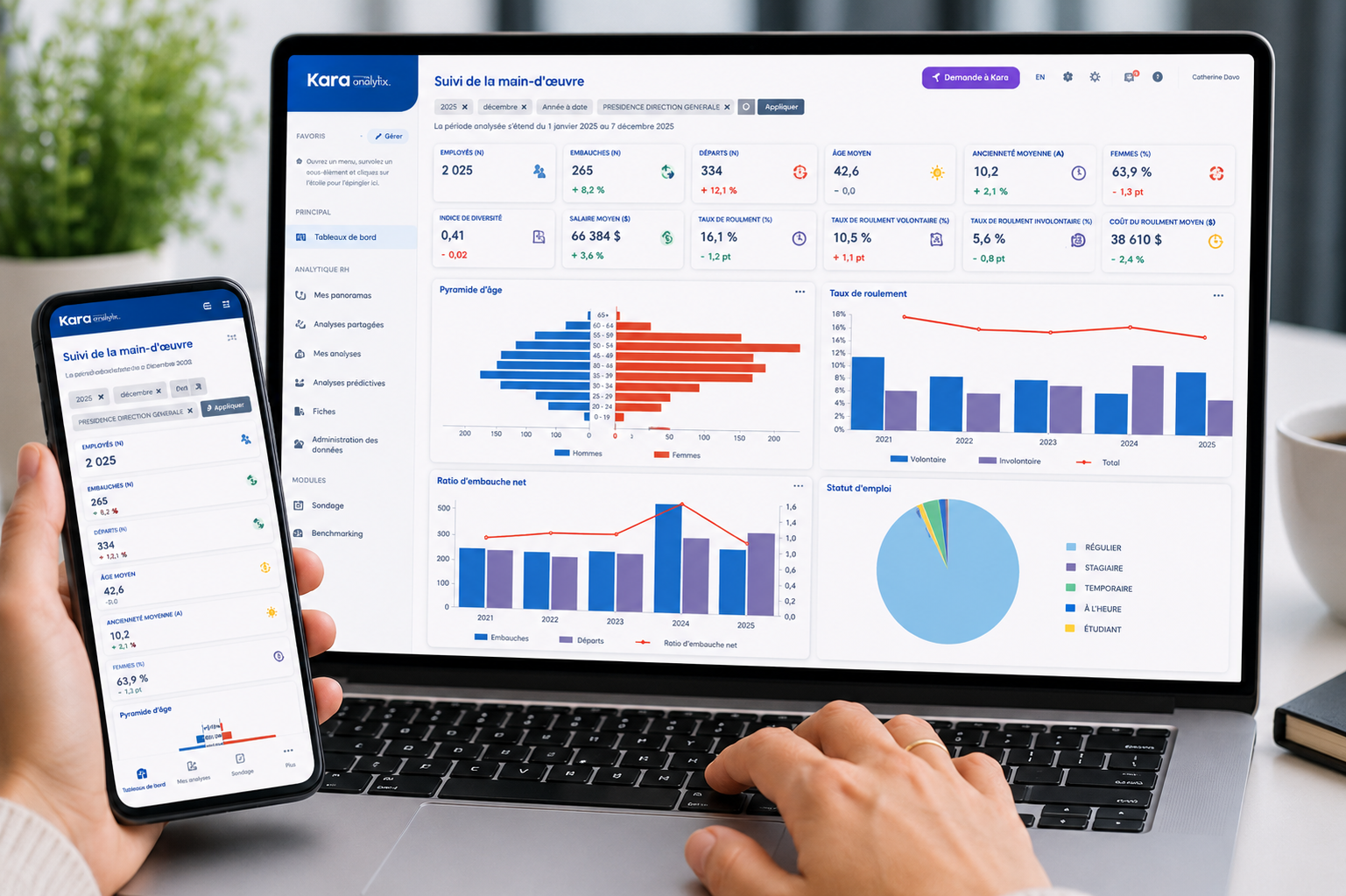
Dashboards also provide immediate access to information, eliminating the need to wait for ad hoc reports. This enables HR Business Partners to respond more quickly when concerning trends emerge and to support managers before issues escalate.
A data-driven approach also strengthens HR’s credibility with leadership. Recommendations are viewed as more evidence-based, making it easier to gain support for HR initiatives and accelerate decision-making.
A new core competency: Data Literacy
Contrary to popular belief, the HR Business Partner of the future does not need to become a data scientist. However, they must be comfortable reading, interpreting, and using data.
This includes the ability to:
Building a data-driven culture also requires taking a critical look at data quality. Incomplete metrics, inconsistent definitions across teams, or inaccurate data entry can quickly distort analyses and lead to poor decisions. Tomorrow’s HR Business Partner must therefore be able to challenge the data they rely on, understand its limitations, and ensure that their recommendations are based on accurate, reliable information.
This competency, commonly known as data literacy, goes far beyond simply reading dashboards. It also involves understanding where data comes from, evaluating its quality, and translating insights into meaningful recommendations for managers. Increasingly, it is becoming just as fundamental as expertise in employee relations or change management.
Artificial Intelligence will also transform the role
Artificial intelligence will accelerate this transformation. Over the coming years, many tasks related to reporting, data consolidation, and descriptive analysis will become increasingly automated. As a result, HR Business Partners will spend less time gathering information and more time interpreting it.
In other words, their value will no longer lie in producing reports, but in explaining what the data means and helping managers make better decisions. AI will not replace the HR Business Partner. Instead, it will automate many of the routine tasks that have historically limited the time available for strategic advising.
AI will also make data exploration much easier. Rather than building complex reports or dashboards themselves, HR Business Partners will be able to ask questions in natural language, receive immediate explanations, and dive deeper into their analyses. This will make HR data far more accessible across the organization.
The HR Business Partner of tomorrow
Tomorrow’s HR Business Partner will confidently navigate between two worlds.
They will no longer be simply HR experts—they will become translators between data and decision-making.
The future of the HR Business Partner is not about choosing between people and data. It is about combining the strengths of both. Organizations will always need professionals who understand people, teams, and organizational culture. But they will also need strategic partners who can transform data into meaningful actions and informed business decisions.
Data will never replace judgment, experience, or the trusted relationships HR Business Partners build with managers. However, it will strengthen their ability to influence decisions, demonstrate the value of HR initiatives, and contribute more directly to business performance.
Perhaps that is the greatest evolution of the role: the HR Business Partner will no longer be simply a trusted advisor. They will become a true strategic partner—one who connects people challenges to business outcomes through the intelligent use of data.
HR reporting rarely appears as a separate expense on an
Most organizations do not have an HR data problem. They
Not every organization approaches HR reporting the same way. Some
Manual HR reporting often costs more than organizations realize. The
HR reporting can be automated by connecting data from your
For many years, the HR Business Partner (HRBP) role was
You have an HR dashboard. But are you actually making
Digital transformation has become a top priority for organizations. Yet
Digital transformation has become a strategic priority for organizations of
Data has become an essential driver for HR teams. Yet
Where Does Your Organization Really Stand?
Compare your retention, turnover, absenteeism, and internal mobility metrics using the benchmarks from the 2026 HR Benchmarking Report.