Blog Details
- Home
- The Financial Value of Predictive HR Analytics: A Still-Underestimated Lever

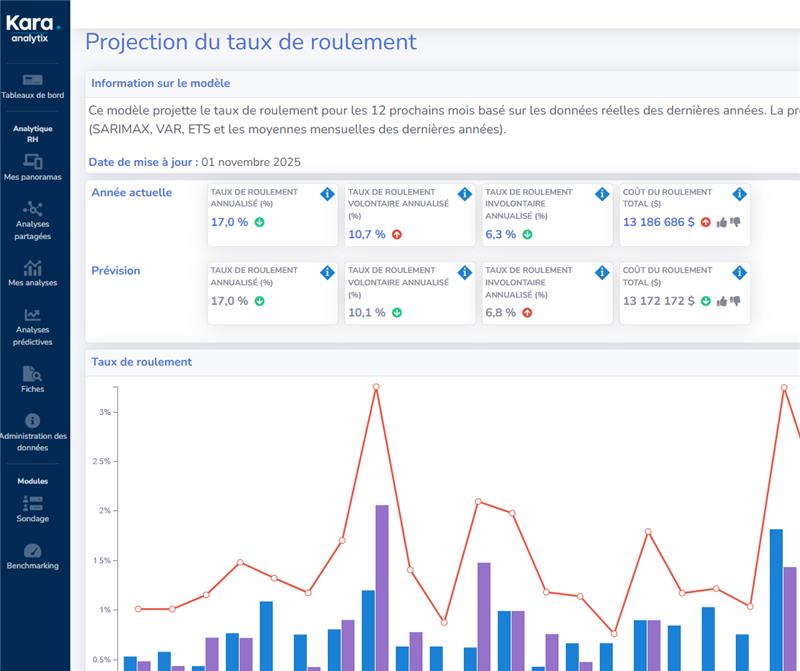
For far too long, the HR function has been perceived as an expense. Today, with the rise in popularity of predictive analytics, it is becoming a true driver of value creation. By anticipating turnover, absenteeism, or even departure risks, HR professionals are able to directly influence costs, productivity, and the overall performance of the organization.

Predictive analytics makes it possible to answer a concrete question:
👉 “Taking current trends into account, what will the financial impact be in the next three, six, or twelve months?
Prediction transforms an abstract reality (e.g., “we’re losing a lot of employees”) into tangible and actionable data:
It is precisely this ability to quantify the impact that gives predictive analytics its strategic value.
Turnover is a costly and often underestimated phenomenon.
In most organizations, replacing an employee costs between 30% and 400% of their annual salary, depending on the type of position (to learn more about the cost of turnover, click here).
Simple example
If a company loses 20 employees per year from this job group, this represents:
$825,000 in direct turnover costs
And those are only the visible costs.
What predictive analytics adds
A predictive model can identify:
Result: initiatives are prioritized where the financial impact is greatest, and departures are prevented before they occur.
Absenteeism is expensive—very expensive.
For an absent employee in the manufacturing sector:
According to the Conference Board (Canada), the direct cost of absenteeism averages 2.1% of the gross payroll.
Example
Company with 300 employees
Payroll: $18M
Absenteeism = 2.1%
Actual annual cost: $378,000
With predictive analytics, the company is able to know:
This allows for action:

Imagine a company with 150 employees where the annual turnover is 18%.
That corresponds to 27 departures per year over the last year.
Average cost per departure (conservative): $30,000
Total annual turnover cost: $810,000
The intervention
The HR team implements a predictive model that:
By targeting:
HR succeeds, in 6 months, in reducing turnover from 18% → 12%.
Financial results
Additional value generated
Total value generated: $350,000 in a single year
Investment required: an analytical solution + training → $30,000
ROI: 10 to 1.
Organizations that master predictive analytics:
Meanwhile, those that still operate on “intuition” react too late, spend more, and lose their market advantages.
Predictive analytics makes it possible to transform HR issues into concrete financial data. But of course, there are certain prerequisites to follow.
And when management can see the impact in dollars—not just in charts—the value of human resources will take on a new dimension.
The message is simple:
You can’t improve what you can’t measure… and you can’t predict what you can’t analyze.
Most organizations do not have an HR data problem. They
Not every organization approaches HR reporting the same way. Some
Manual HR reporting often costs more than organizations realize. The
HR reporting can be automated by connecting data from your
For many years, the HR Business Partner (HRBP) role was
You have an HR dashboard. But are you actually making
Digital transformation has become a top priority for organizations. Yet
Digital transformation has become a strategic priority for organizations of
Data has become an essential driver for HR teams. Yet
Human resources generate an impressive amount of data. Recruitment, compensation,